Deepdub
Deepdub is an enterprise AI dubbing and voice localization platform that translates video audio into multiple languages while preserving voice character and lip-sync synchronization, with API access for production pipeline integration.
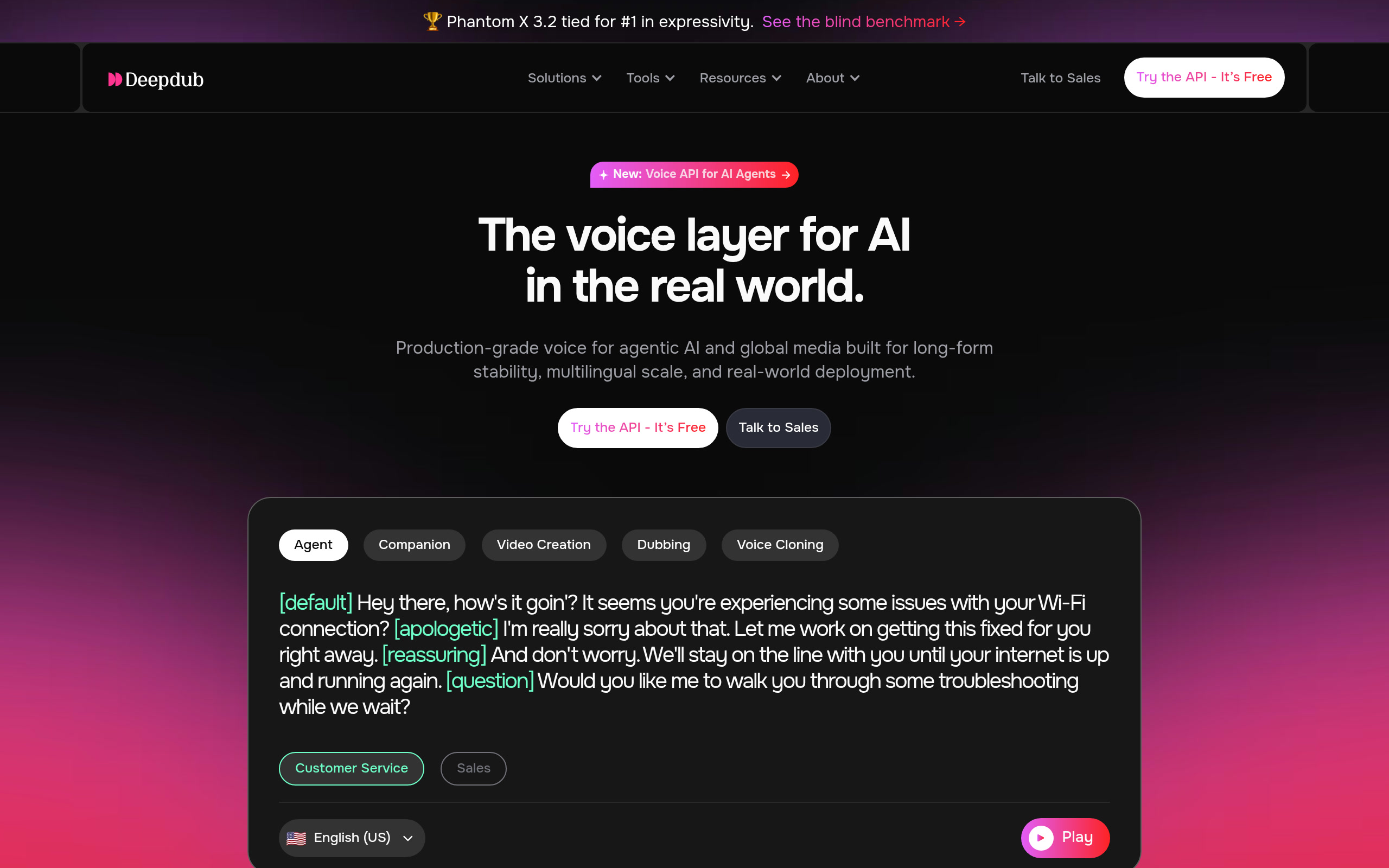
Deepdub: AI Dubbing and Voice Localization Platform for Video Content (2026)
Deepdub is an AI dubbing and voice localization platform by Deepdub Inc. that translates and synchronizes video audio into multiple languages using voice synthesis and lip-sync technology. It serves media companies, streaming platforms, content distributors, and enterprises that need to localize video content at scale without traditional dubbing studio costs and timelines. Deepdub is not a general video editing tool and is not suitable for users who need text-to-video generation or basic subtitle creation.
Quick Fact Sheet
| Feature | Details |
|---|---|
| Primary use case | AI video dubbing and voice localization for multilingual distribution |
| Best for | Media companies, streaming platforms, e-learning providers, corporate L&D |
| Access type | Web platform (enterprise-oriented) |
| Input types | Video files with audio tracks; source language audio |
| Output formats | Video with dubbed audio tracks; Not all formats publicly documented |
| Output resolution | Dependent on source video |
| Max video duration | Not publicly documented |
| Generation speed | Not publicly documented (varies by content length and language pair) |
| Watermark (free tier) | No public free tier; enterprise and API pricing |
| Language support | Multiple languages (exact list not publicly documented) |
| API availability | Yes — API access available for integration |
| Integrations | API; enterprise workflow integration |
| Collaboration | Enterprise team workflows supported |
| Pricing model | Contact for pricing (enterprise) |
| Free plan | None publicly available |
| Paid plans | Enterprise pricing; contact sales for details |
What Deepdub Does Well
Voice Character Preservation in Dubbing
Deepdub's AI preserves the emotional tone, speaking style, and character of the original voice when synthesizing dubbed audio in a target language. This differs from generic TTS dubbing tools that produce flat, robotic synthetic voices — Deepdub's output samples demonstrate voice-matched dubbing that retains speaker identity across languages.
Lip-Sync and Timing Synchronization
The platform handles audio timing synchronization with the original video's lip movements and scene cuts. Dubbed audio is adjusted to match the natural pacing and lip movement of the original performance, producing more professional output than tools that simply translate and re-read text without timing consideration.
Multi-Language Dubbing at Scale
Deepdub is built for enterprise-scale content localization — dubbing the same source video into multiple languages simultaneously. This makes it practical for streaming platforms, e-learning providers, and corporate training departments that need to distribute content in 5-20 languages as part of a standard production workflow.
API Integration for Production Pipelines
Unlike most AI dubbing tools that are web-only consumer applications, Deepdub offers API access for integration into existing video production and distribution pipelines. This enables content distributors and platforms to automate dubbing as a step in a larger content management workflow.
Enterprise Quality Control
Deepdub positions itself for media-grade quality requirements, supporting review workflows and production team oversight rather than fully automated one-click dubbing. This makes it more suitable for professionally distributed content where quality standards must meet broadcast or streaming platform requirements.
Known Limitations
- Pricing not publicly listed: Deepdub does not publish pricing on its website — all plans require direct sales contact. This makes cost comparison with alternatives (Dubverse, Dubs.io, CAMB.AI) difficult without a sales conversation.
- Enterprise minimum implied: The platform's documentation and positioning target enterprise media companies and streaming platforms — not individual creators or small production teams who need affordable self-serve dubbing.
- Language coverage not fully documented: The complete list of supported language pairs is not prominently published, making it difficult to confirm coverage for less-common language markets before engaging with sales.
- Not a general video editor: Deepdub is specialized for dubbing and localization — it does not provide general video editing, captioning, or other production features outside of the voice localization workflow.
- AI voice artifacts: Like all AI voice synthesis, Deepdub's output may produce unnatural prosody or artifacts in complex emotional scenes or with highly accented speech, particularly for language pairs with significant phonological differences.
Best For
- Streaming platforms and media distributors localizing content libraries into 5-20+ languages
- E-learning and corporate training providers distributing video courses to international employees
- Production studios and post-production companies offering dubbing as a service to clients
- Tech companies building automated video localization into their content distribution pipelines via API
Who Should Look Elsewhere
- Individual creators who need simple, affordable subtitle translation (Submagic, Descript, VEED)
- Small teams needing self-serve dubbing without a sales process (Dubverse, Dubs.io)
- Users who need text-to-video generation rather than audio localization (Runway, Sora, InVideo)
Pricing & Cost at Scale
Deepdub's pricing is not publicly listed — the company operates on an enterprise sales model requiring direct contact to receive a quote. Pricing is likely structured around content volume (hours of video dubbed), number of languages, and API access level. For comparison, consumer-facing dubbing tools like Dubverse offer plans starting at approximately $10-20/month for limited minutes; enterprise dubbing services from traditional providers can cost $1,000-5,000 per hour of content per language. Deepdub positions between these segments targeting professional media workflows.
Technical Details & Integrations
Deepdub provides API access for pipeline integration. The platform handles voice synthesis, timing synchronization, and lip-sync processing. Exact technical specifications (supported codecs, file formats, max duration, language pairs) are not fully documented publicly. Enterprise workflows include review and approval steps for quality control before final delivery.
Getting Started
- Visit deepdub.ai and contact the sales team to discuss your content localization needs
- Provide details on your source content volume, target languages, and quality requirements
- Receive a custom quote and onboarding plan appropriate to your scale
- Integrate Deepdub's API into your content management or distribution pipeline (if needed)
- Submit source video for dubbing and review AI-generated dubbed output before delivery
What Users Are Saying
Deepdub's enterprise positioning means limited public user reviews compared to consumer tools. Industry coverage highlights the voice character preservation technology as a genuine technical differentiator from generic TTS dubbing. Media technology publications cite Deepdub alongside ElevenLabs and Papercup as AI dubbing providers competing for enterprise streaming and distribution contracts.
- Company: deepdub.ai
FAQ
What is Deepdub?
Deepdub is an AI dubbing and voice localization platform that translates video audio into multiple languages while preserving the original voice character, emotional tone, and lip-sync timing. It is designed for enterprise media companies and content distributors.
How is Deepdub different from subtitle tools?
Deepdub replaces the original audio track with synthesized dubbed audio in the target language — viewers hear the content spoken in the target language rather than reading subtitles. This is full AI dubbing, not caption or subtitle translation.
Does Deepdub preserve the original speaker's voice?
Yes. Deepdub's technology is designed to preserve the character, emotional tone, and speaking style of the original voice in the dubbed output, rather than producing generic synthetic voices.
Does Deepdub have an API?
Yes. Deepdub offers API access for integrating dubbing into existing video production and content distribution pipelines.
Is Deepdub suitable for individual creators?
Deepdub is designed for enterprise media companies and platforms, not individual creators. Individual creators needing AI dubbing at lower price points should consider Dubverse, Dubs.io, or CAMB.AI.
Sources
Reviews
No reviews yetSimilar tools in category
Adobe Premiere Pro
Argil
A platform that simplifies and enhances the process of creating engaging presentations.
Atlabs
A platform that streamlines data analysis and visualization for enhanced decision-making.